
Search engine optimization is changing faster than ever. In 2026, SEO is no longer only about choosing keywords and ranking on the traditional Google results page. The rise of AI-powered search, conversational queries, visual search, and changing user behavior is creating new opportunities for businesses to improve their online visibility.
For businesses, the goal remains the same: help the right people discover your brand and find useful answers. But the way people discover information is evolving. Here are some of the most important SEO trends businesses should understand in 2026.
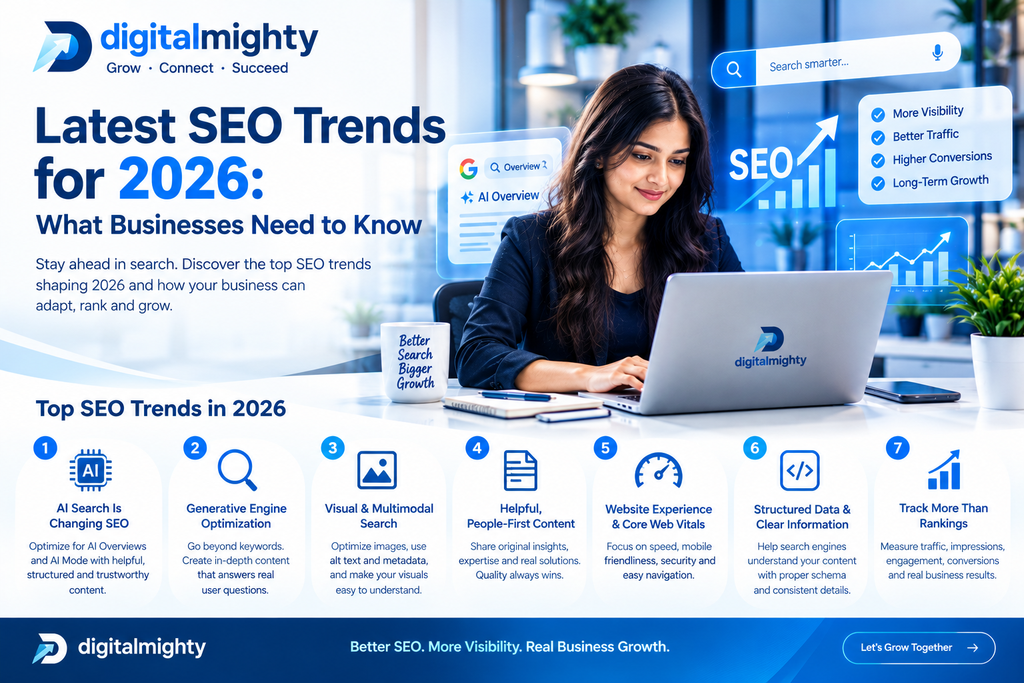
1. AI Search Is Changing SEO
One of the biggest developments in search is the growth of AI-powered experiences such as Google AI Overviews and AI Mode. These features can provide AI-generated answers while also linking users to relevant websites.
Google states that there are no special technical requirements or separate “AI SEO” rules required to appear in these experiences. Traditional SEO fundamentals—such as crawlability, indexing, internal linking, useful content, and good page experience—remain important.
This means businesses should focus on creating content that genuinely answers customer questions rather than trying to manipulate AI systems.
2. Helpful and Original Content Matters More
In 2026, simply publishing large amounts of generic content is not a strong long-term strategy. Businesses should create content based on real expertise, original insights, customer questions, examples, and practical solutions.
Google’s latest guidance specifically highlights the importance of valuable, unique, non-commodity content for visibility in generative AI search experiences.
Instead of asking, “How many articles can we publish?” businesses should ask, “What useful information can we provide that our customers cannot easily get elsewhere?”
3. Optimize for Conversational Search
People increasingly search using natural questions rather than short keyword phrases. For example, instead of searching only for “digital marketing agency Varanasi,” a user might ask, “Which digital marketing services can help my small business get more customers in Varanasi?”
Businesses should therefore create content that answers complete questions clearly. FAQs, detailed guides, comparison pages, and problem-solving articles can help cover different types of search intent.
4. Visual and Multimodal Search Is Growing
Search is becoming more visual. Google introduced Search Console reporting for web multimodal search in September 2026, including insights related to Google Lens, Circle to Search, image uploads, and “Search this image.”
This makes image optimization increasingly useful. Businesses should use relevant images, descriptive filenames, useful alt text, and supporting page content to help search engines understand their visual assets.
5. Local SEO Remains Important
For businesses serving a specific city or region, local SEO continues to be an important part of digital marketing.
Keeping your Google Business Profile accurate, maintaining consistent business information, collecting genuine customer reviews, and creating locally relevant website content can help customers discover your business when searching for nearby services.
For example, a local company can create useful content around topics such as “digital marketing services in Varanasi” or “SEO strategies for local businesses.”
6. Measure SEO Beyond Rankings
SEO success should not be measured only by keyword positions. Businesses should also monitor organic traffic, leads, conversions, engagement, and visibility across different search experiences.
Google introduced dedicated Search Console reporting for visibility in generative AI features, allowing website owners to examine impressions and the pages appearing in AI-powered search experiences.
This gives businesses more ways to understand how their content is being discovered.
7. Brand Trust and Expertise Matter
As AI-generated content becomes easier to produce, businesses need to differentiate themselves through expertise, authenticity, and a recognizable brand voice.
Publishing original experiences, expert insights, useful case studies, customer-focused guides, and trustworthy information can help establish stronger relationships with both users and search engines.
Conclusion
SEO in 2026 is becoming broader and more user-focused. AI search, conversational queries, visual search, local SEO, original content, and better performance measurement are all shaping the modern search landscape.
The key lesson is simple: do not chase every new SEO trick. Build a technically healthy website, understand your audience, create genuinely useful content, and continuously improve based on real data.
For businesses that follow this approach, SEO can become more than a way to gain website traffic—it can become a long-term channel for visibility, trust, leads, and sustainable growth.
DigitalMighty helps businesses build practical digital marketing and SEO strategies designed for the changing online landscape.
Risks / dependencies
- SEO results depend on competition, website quality, search behavior, and ongoing search-engine changes.
- AI-search visibility is not guaranteed, even when SEO best practices are followed.
- Businesses should review Search Console and analytics data regularly rather than relying on rankings alone.